The website development process, step by step
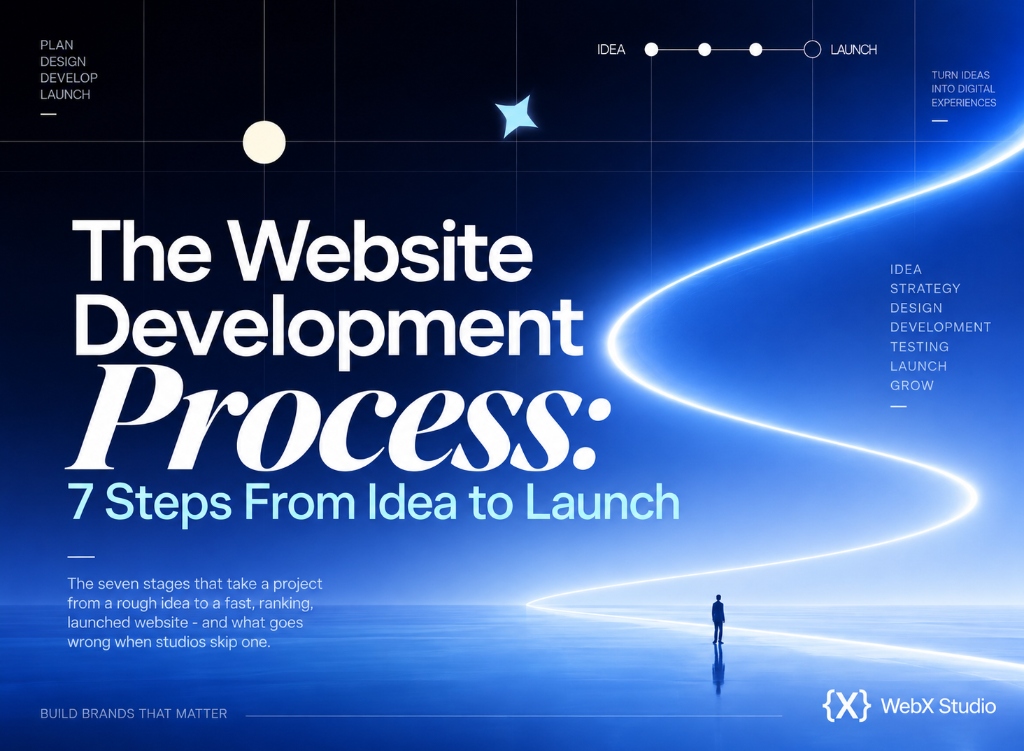
Great websites aren’t improvised - they’re built through a repeatable process. Here are the seven stages that take a project from a rough idea to a fast, ranking, launched website, and what happens (or goes wrong) at each one.

Ask ten agencies how they build a website and you’ll get ten answers - but the good ones all follow a version of the same seven stages. Understanding this website development process helps you brief better, spot a studio that skips steps, and know exactly where your project is at any moment.
At Web{X} Studio this is roughly how every build runs. Here it is, stage by stage.
Discovery → Design → Front-end development → Back-end & CMS → Content & SEO → Testing & QA → Launch & maintenance. Miss one and it usually resurfaces later as a delay, a bug, or a page that won’t rank.
Step 1 — Discovery & strategy
Before a single pixel or line of code, you define the why: business goals, target audience, scope, sitemap and how success will be measured. This is the cheapest place to make changes and the most expensive place to skip. A clear brief here prevents the painful rework of building the wrong thing beautifully.
Step 2 — UX & UI design
Next, the site is designed - usually in Figma. Wireframes map the structure and user journey; high-fidelity designs add brand, typography, colour and motion. This is where UI/UX decisions that drive conversions get made. Sign-off here means everyone agrees what’s being built before development starts.
Step 3 — Front-end development
Now the design becomes a real, responsive interface - built with clean HTML, CSS and JavaScript (or a no-code platform like Webflow). Good front-end work is pixel-perfect to the design, fast on mobile, and accessible. This is where a great design either comes to life or gets flattened by sloppy build.
Step 4 — Back-end & CMS
For anything beyond a static page, the back-end wires up the logic: databases, user accounts, payments, integrations, and a content management system so you can edit the site without a developer. The more your site does, the bigger this stage.
Want a team that runs this process for you?
We take projects through all seven stages - discovery to maintenance - with clear milestones you can see. Tell us your goal and get an itemised quote within two business days.
Start your projectStep 5 — Content & SEO
A website without content is an empty shell. Final copy, images and video go in - each image optimised, each page given a unique meta title, description and structured data. This is where SEO is baked in, not bolted on: clean headings, internal links and fast media decide whether you rank. Unready content, by the way, is the single most common cause of delayed launches.
Step 6 — Testing & QA
Before launch, everything is tested: across browsers and devices, for broken links, form failures, accessibility and - crucially - speed. A quality studio checks Core Web Vitals here and fixes anything that fails, because a slow site that “works” still loses customers and rankings.
Step 7 — Launch & maintenance
Launch is a milestone, not the finish line. The site is deployed, analytics and search tools are connected, and redirects are set so no SEO is lost. Then comes maintenance: security updates, backups, edits and ongoing improvements. A website is a living asset - the ones that keep winning are the ones that keep getting looked after.
A good process doesn’t make websites slower to build - it makes them faster to build right, the first time.
How long does the whole process take?
Roughly: a landing page in 1-2 weeks, a business website in 3-6 weeks, and ecommerce or custom builds in 6-12 weeks. The biggest variable isn’t the studio - it’s how fast you supply content and feedback. We cover this in detail in how long website development takes.
The takeaway
The website development process exists to remove guesswork and risk. When each stage is done properly - discovery through maintenance - you get a site that launches on time, works flawlessly and ranks. When stages get skipped to save a week, the cost almost always comes back later, with interest.